

Ready for E-Invoicing?
How SAP Concur supports your digital transformation
Author: Lea Schuh06. May 2025 SAP Concur
Content:
In today's fast-paced business world, digital processes are not just a convenience - they're a necessity. With the introduction of the Growth Opportunities Act (Wachstumschancengesetz), Germany is set to revolutionize the B2B sector by mandating e-invoicing. This decisive step toward digitalization promises to streamline operations, reduce costs, and enhance security. Businesses must adapt their systems and workflows to comply with this new regulation. However, in doing so, they can unlock new levels of efficiency and security in their invoicing processes.
In the era of digital transformation, e-invoicing is not just a trend - it's a game-changer for financial processes. Businesses can reap substantial benefits, including streamlined operations, significant cost savings on printing and paper, and a reduction in manual errors through automation. Although adapting to these changes may seem challenging, structured transition periods and practical solutions, such as those offered by SAP Concur, can help companies manage the shift effectively.
E-invoices are revolutionizing the way businesses handle billing, but what exactly is an E-Invoice?
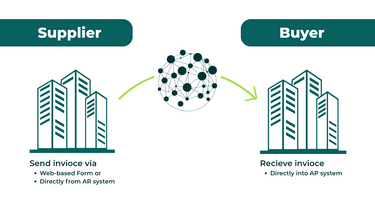
An electronic invoice is a digital document that enables businesses to send, receive, and process billing information electronically.This modern approach offers significant benefits over traditional paper invoices. Unlike traditional invoices, e-invoices are formatted in a structured, machine-readable way, allowing for seamless automation and easier integration into financial and accounting systems. For instance, e-invoices can be automatically processed by accounting software, reducing the need for manual data entry and minimizing errors.
Formats of an e-invoice
In Germany, e-invoices primarily follow two formats: "XRechnung" and "ZUGFeRD". These formats adhere to the EU standard EN 16931, which was introduced to harmonize electronic invoicing across Europe. This standardization simplifies cross-border transactions and enhances digital communication between businesses, government entities, and other organizations (B2B, B2G, and G2G). For instance, "XRechnung" is often used for transactions with government entities, while "ZUGFeRD" is popular in the B2B sector.
E-Invoice or not E-Invoice, that is the question.
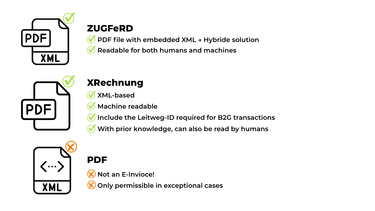
The practice of invoicing in Germany is undergoing a significant transformation due to the new regulations. Previously, PDFs were considered valid invoices even without structured data. In future, the process will be more flexible but PDFs without structured data will no longer be recognised as valid e-invoices. However, the new regulations do not apply to all transactions. These include for example, tickets for personal transportation (such as train tickets) and small-value invoices with a transaction value of less than 250€.
Suppliers will be able to issue e-invoices for individual transactions without needing the buyer's prior consent. However, both parties must agree on a transmission channel.

How does Concur support this digital tranformation?
According to the Federal Ministry of Finance, an email address is a permissible channel. As of January 2025, SAP Concur supports e-invoicing for Germany via E-Mail Channel. Employees can email e-invoices to a special Concur email address. The original e-invoices will be stored in the Concur Expense database, with visual files displayed for convenience and approval.
Are there any deadlines regarding the implementation?
Germany's mandatory e-invoicing in the B2B sector will be rolled out in phases with full implementation planned by 2028. This multi-stage approach is designed to facilitate a smoother and easier transition for companies, giving them the needed time to update their systems and processes accordingly.
Key Deadlines
- Starting January 2025: Suppliers may issue electronic invoices without the buyer's prior consent. Buyers must then be able to receive invoices in the format of EU standard EN 1693.
- Starting January 2027: Suppliers with an annual turnover exceeding 800,000 euros must exclusively issue electronic invoices. Paper or PDF invoices will no longer be permitted. The EDI procedure remains valid, provided the invoices adhere to EN 16931 standards.
- Starting January 2028: All suppliers must use electronic invoices for domestic B2B transactions. Other formats will no longer be permitted.
No need to worry - during the transition period, invoices can continue to be issued on paper or as a simple PDF file.
Travel & Expense Management with SAP Concur
National or international business travel is part of everyday life for many companies. Planning, approving and invoicing these trips is the core competence of SAP Concur, the cloud-based solution for business travel management from SAP.

