
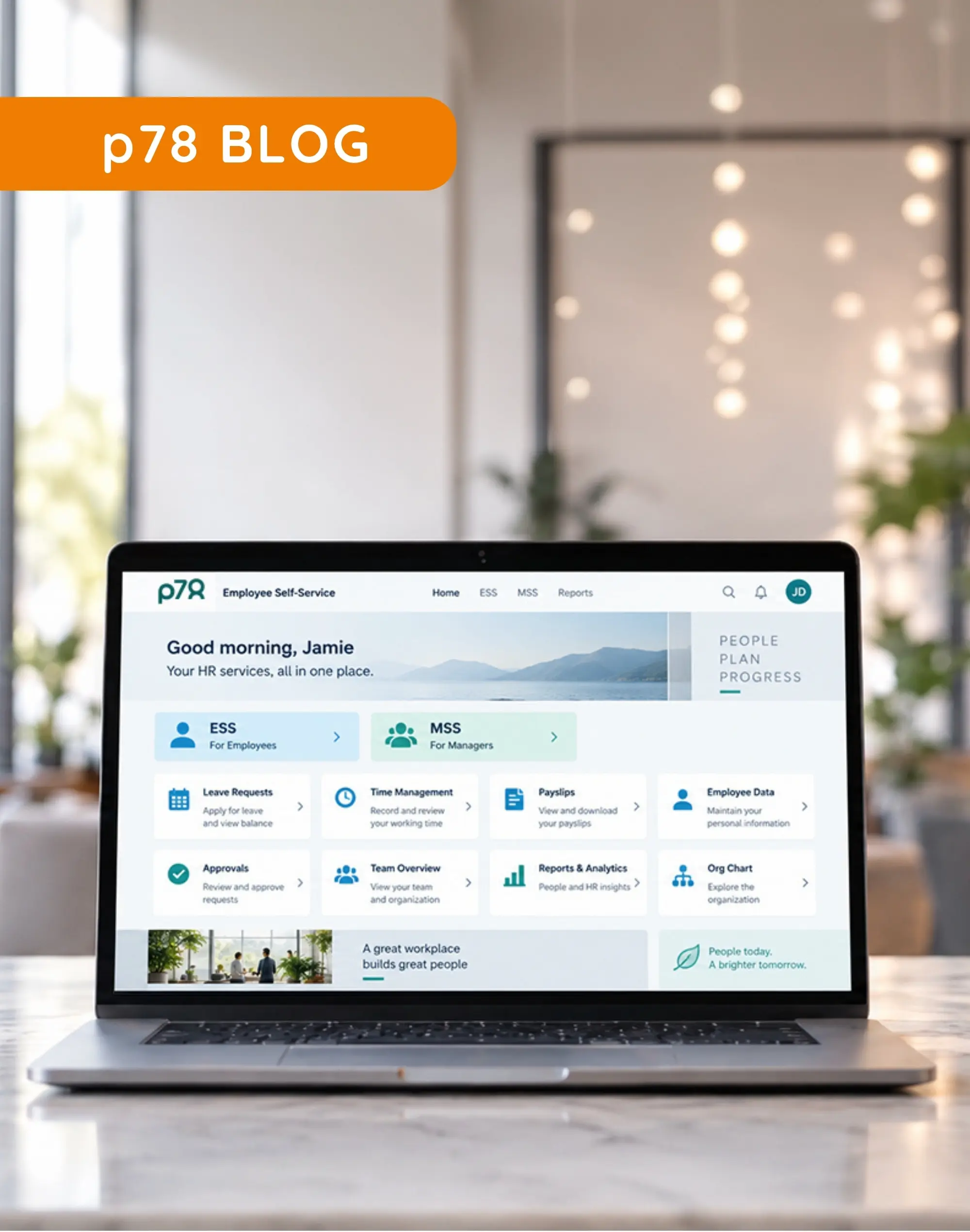
What ESS and MSS can do, which processes they support – and what happens to your self-service investments under SAP SuccessFactors.
SAP Employee Self-Service (ESS) and Manager Self-Service (MSS): How Self-Services Reduce the Workload for HR
8 September 2026 SAP HCM
Contents:
Key Takeaways
- ESS enables employees to manage their own HR data and processes – via web and mobile, without paper forms.
- MSS gives managers central access to team data, reports and approvals.
- The benefits: fewer routine HR tasks, no process breaks, faster turnaround times and better data quality.
- The technology: SAP Fiori / SAPUI5 – for classic SAP ERP HCM as well as SAP SuccessFactors.
- Looking ahead: ESS/MSS is evolving as organisations move to the cloud. Existing investments can be protected – provided the transition is planned carefully.
What is SAP Employee Self-Service (ESS)?
SAP Employee Self-Service (ESS) is a web-based application that enables employees to view and maintain their own HR data and initiate related processes independently. Instead of completing a form and sending it to HR via internal mail, employees log in to a portal and make the change directly in the system.
The application is closely integrated with the HR backend systems. For example, when an employee enters new bank details, the information is updated directly in the system after an optional approval workflow. This eliminates the need for HR staff to transfer the data manually.
Take-away
ESS shifts standard HR tasks to where they originate – to employees themselves. This frees up HR teams to focus on more strategic work.
What is Manager Self-Service (MSS)?
While ESS is designed for all employees, Manager Self-Service (MSS) is aimed at managers. MSS gives managers central access to activities within their area of responsibility and enables them to initiate HR processes and digitally approve requests, such as leave requests submitted via ESS. ESS and MSS work together and form the foundation of modern HR management.
And PA-AS? Self-Services for HR Administration
In addition, HR Administrative Services (PA-AS) enable HR administrators to handle processes such as hiring or employee departures entirely within the portal – without accessing the system via the classic SAP GUI.
Take-away
ESS for employees, MSS for managers and PA-AS for HR administration – three integrated self-service layers.
Which processes do ESS and MSS cover?
Self-services cover almost the entire employee lifecycle. The most common use cases include:
Master Data and Time Management
Moving house, changing a name or updating bank details: employees maintain their own master data. Daily time recording and corrections to incorrect time entries are also handled directly in the portal.
Absence Management
Employees request annual leave, sick leave or educational leave via a calendar. The system checks the remaining leave entitlement in the background, the manager receives a notification for approval, and the request status remains transparent at all times.
Payslips and Documents
Payslips are provided digitally as PDFs and can be accessed and archived at any time – reducing postage, printing costs and paper usage.
Take-away
From address changes to digital payslips, ESS/MSS keeps recurring HR processes fast, seamless and fully digital.
What are the benefits of using ESS/MSS?
The pressure to digitalise is high: In a representative 2025 Bitkom survey of 603 companies with 20 or more employees, 78 percent feared that Germany would lose economic ground without further digitalisation. For the first time, a majority of 53 percent also reported difficulties in managing this transformation – up from 34 percent in 2022. Self-services provide a practical way to turn this pressure into greater efficiency in HR.
The greatest potential lies in reducing the workload for HR: routine tasks shift to employees, giving HR teams more time for strategic work. Another 2025 Bitkom survey of 852 companies shows how much potential remains untapped: 49 percent can imagine using chatbots to handle internal HR enquiries, but only 9 percent have implemented them so far.
For employees, the main benefit is greater independence: HR information is available around the clock and on mobile devices, with a user experience comparable to the digital services they use in their everyday lives. At the same time, this reduces error rates because data is maintained at the source, as well as costs through less paper and fewer manual tasks.
Take-away
ESS/MSS reduces administrative workload and error rates while improving the employee experience – delivering greater efficiency without compromising usability.
What to consider when implementing ESS/MSS
Self-services are rarely a purely IT-driven decision. They also require organisational change. Experience from p78 projects shows that the SAP standard provides the starting point, while the real value comes from mapping processes individually and end to end.
From practice: mapping complex processes end to end
One example is an overtime request process implemented by p78 for a company in the automotive industry. Managers (MSS) or employees (ESS) initiate overtime requests directly in the SAP system – with a flexibly configurable, multi-stage approval workflow, automated notifications, support for mass requests and audit-proof, seamless processing through to SAP HCM Time Management (PT) and Payroll (PY). In large organisations, tens of thousands of such requests can arise each year – making end-to-end processing a key factor in reducing administrative workload.
A second example is employee-centric workforce scheduling at dm-drogerie markt: four integrated apps allow employees to schedule themselves via smartphone (ESS), while planners and managers (MSS) review and approve schedules. The solution is centred around individual stores, takes extensive co-determination rights into account and is fully integrated with the existing SAP HCM Time Management (PT) environment.
Key organisational considerations
- Prioritise change management early. New tools often face initial scepticism, so communicate the benefits from the outset.
- Think mobile first. Employees without a fixed PC workstation in particular rely on self-services via mobile devices – and adoption depends heavily on the mobile experience.
- Training and support. Short tutorials and a low barrier to entry help increase adoption.
Take-away
SAP standard provides the foundation, but project success depends on seamless, co-determination-ready and mobile-friendly processes. Change management is key to user adoption.
What happens to ESS/MSS under SAP SuccessFactors?
This is the question many existing customers are currently facing – and where sound advice goes beyond simply describing the available options.
The starting point: Classic ESS/MSS scenarios are based on SAP Fiori / SAPUI5 running on SAP ERP HCM. With maintenance for classic SAP HCM ending on 31 December 2027 and organisations moving towards SAP SuccessFactors, this raises an important investment question: What happens to the self-services already in place?
What is clear: In SuccessFactors, self-services are a native part of Employee Central – for example through Quick Actions, the People Profile and absence processes. Self-service functionality is not disappearing; it is moving to a new technical foundation.
The key decision concerns custom self-services – specifically the tailored Fiori applications illustrated above. In principle, there are several options:
- continue running the applications on ERP HCM / S/4HANA,
- rebuild them in SuccessFactors,
- or migrate or embed existing Fiori applications into the SuccessFactors user interface.
Take-away
Self-service is here to stay – only the technical foundation is changing. Existing investments can be preserved with a clear transition strategy, whether through continued operation, redevelopment or migration.