

2024 in Review
Business Travel Between Stability and Strategic Transformation
Author: Lea Schuh01. September 2025 SAP Concur
Content:
The year 2024 marked a phase of consolidation, realignment, and strategic repositioning for the German business travel market. The latest VDR Business Travel Analysis offers compelling insights into how the industry has evolved following the pandemic-driven disruption - highlighting clear trends, emerging challenges, and promising opportunities for Travel & Expense Management in Germany.
Less Volume, More Impact
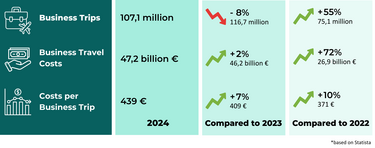
In 2024, business travel reestablished itself as a core element of corporate life in Germany, but with a distinctly strategic focus. Total travel spend rose slightly to €47.2 billion, a 2% increase compared to the previous year. At the same time, the number of trips declined moderately by 8%, down to 107.1 million. This drop is not a sign of restraint, but rather a reflection of a deliberate shift: German companies are traveling more selectively and efficiently.
Instead of maximizing trip counts, the emphasis is now on value. Meetings are consolidated, routes optimized- saving resources and reducing strain on employees. The average cost per trip rose to €439, indicating a more intentional travel approach where quality, comfort, and sustainability take precedence.
For companies, this means travel expenses are no longer viewed merely as a cost factor, but as a strategic investment-deployed with purpose and focused on impact rather than volume.
More Global, More Focused, More Demanding
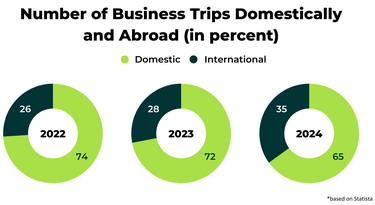
A clear trend emerged in Germany’s business travel landscape in 2024: companies are acting more globally and increasingly prioritizing face-to-face interactions across borders. The share of international business trips rose to 35%, a significant increase compared to 28% in 2023 and 26% in 2022. European destinations are particularly popular, accounting for 25% of all trips.
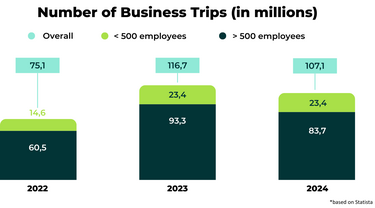
The dynamics vary notably by company size. While large enterprises maintained a stable travel volume with 23.4 million trips, small and medium-sized businesses significantly reduced their activity—from 93.3 million to 83.7 million trips.
For travel managers in Germany, this shift means rising complexity. International travel is gaining importance, and with it come higher demands for planning, control, and sustainability. Those who establish clear, adaptable processes can unlock real value for their organizations.
Quality over Quantity
2024 confirmed a key shift in the German business travel market: travel is no longer a routine activity, but a targeted investment with a clear purpose.
Small and medium-sized enterprises (SMEs) in Germany are leading this development. Despite a decline in travel volume, they contributed €36.5 billion to total business travel spending—accounting for around 75% of the market. Their focus lies on high-impact travel occasions such as client engagement, market expansion, or critical project phases. These trips are less frequent but more intensive—and therefore more costly. Rising market prices particularly affect companies without large-scale travel agreements.
Large corporations also increased their travel budgets—from €10.3 billion to €10.7 billion—and are placing greater emphasis on quality. Sustainable mobility, CO₂ offsetting, and enhanced safety standards have become standard components of corporate travel policies.
The message is clear: business travel in Germany remains relevant, but only when it delivers real value. Those who travel do so with foresight and a strategic mindset.
Digital Is the Norm
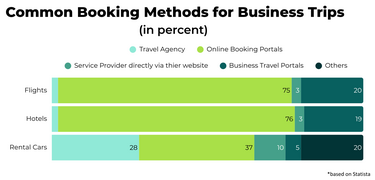
In Germany, business travel booking is now predominantly digital—but approaches vary. Around 75% of flight and hotel bookings are made via standard online portals or booking tools. Only about 20% of companies rely on specialized business travel platforms, reflecting different strategies in travel management - from fast self-booking to centrally managed, complex solutions.
Direct contact with travel agencies plays a minimal role today - except in one area: rental car bookings. Here, 28% of companies still prefer personal consultation, especially for last-minute changes or flexible rebooking options. Many bookings also happen spontaneously on-site, such as at airports or local rental stations.
Cost structures reveal a clear pattern: transportation remains the largest budget item. 60% of German companies report that transport accounts for 51–75% of total travel costs. In contrast, accommodation is significantly less expensive -71% of companies say it makes up no more than 25% of their travel budget.
The takeaway: While booking processes in Germany are largely digital and efficient, mobility continues to drive costs. For companies, this means that managing travel expenses requires more than just tools—it demands smart, strategic planning.
Business Travel in Transition: Strategic, Flexible, Future-Oriented
2024 marked a turning point for business travel management in Germany. What was once routine is now being redefined. Business travel is increasingly shaped by societal shifts, technological innovation, and growing expectations around sustainability and employee well-being.
Mobility is now viewed through the lens of environmental responsibility. Travel safety goes beyond physical protection - it includes mental health and digital security. At the same time, new work models like blended travel and workation are gaining traction, making traditional business trips more flexible and personalized.
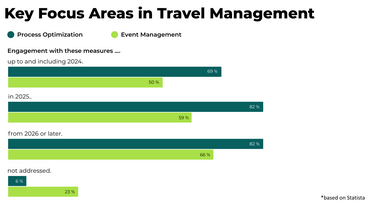
German companies are responding: 69% actively worked on streamlining travel processes in 2024, and by 2025, that figure is expected to rise to 82%.
The key insight: Business travel has become more complex - and more strategically important. Planning today means balancing efficiency with adaptability, while keeping sustainability, safety, and individual needs firmly in view.
Conclusion: Business Travel 2024 – Shaping the Future with Three Guiding Principles
2024 was not a year of records, but one of maturity - especially within the German business travel market. Business travel has become more selective, strategic, and sustainable. For Travel & Expense Management, this means rising expectations and a shifting role: planning must now be more thoughtful, agile, and open to innovation. Three key principles help set the course for tomorrow’s travel strategies:
Focus Over Frequency - It’s not about how often you travel, but why. The business value of each trip matters more than the volume.
Rethink Mobility - Business travel is not one-size-fits-all. Solutions must be tailored to industry, region, and company size - from sustainable transport options to flexible booking models.
Actively Shape the Future - Artificial intelligence, sustainability, and employee well-being are no longer side topics - they’re central drivers of change. They shape processes, policies, and the entire travel culture, offering real opportunities for transformation.
Travel & Expense Management with SAP Concur
National or international business travel is part of everyday life for many companies. Planning, approving and invoicing these trips is the core competence of SAP Concur, the cloud-based solution for business travel management from SAP.